Not just Hypervisor Agnostic, Hypervisor Version Agnostic!

Its well known that Nutanix is Hypervisor agnostic supporting ESXi, Hyper-V and KVM, but what most people either don’t know, or haven’t considered, is the fact the Nutanix Operating System (NOS) version is not dependant on the hypervisor version.

What does this mean?

You can run the latest and greatest NOS 4.1.x releases on ESXi 5.0 , ESXi 6.0 or anything in between. In fact, you could run older versions of NOS such as 3.x with vSphere 6.0 as well (although I see no reason you would do this.)

Why is this important?

This past week I was discussing with some government customers how they can perform upgrades of NOS using our 1-Click upgrade, and I was asked a similar question on several occasions:

“What version of ESXi do we need?”

The reason the customers asked this question is because for large environments, changing/upgrading the hypervisor can be a significant project requiring Design/project management and implementation labor which could cost huge amounts of money when the only goal is to increase storage performance or functionality.

NOS can be upgraded independent of the Hypervisor (and without performing a single vMotion or putting hosts into maintenance mode). This ensures that customers who cannot or do not wish to upgrade ESXi for any reason, continue to benefit from the ever increasing performance and feature set of NOS.

While hyper-converged solutions like Nutanix combine the compute/hypervisor layer and the storage layer delivering numerous benefits over traditional 3-tier architecture, it’s a significant advantage to be able to independently upgrade the compute or storage layer.

This is something Nutanix delivers which is just one of the many ways we make our solution “Uncompromisingly Simple”.

Oh, did I mention NOS also provides support for 1-Click Hypervisor and Firmware upgrades ? 🙂

Related Articles:

In-Kernel verses Virtual Storage Appliance

Let me start by asking, What’s all this “In-Kernel verses Virtual Storage Appliance” debate all about?

It seems to me to be total nonsense yet it is the focus of so called competitive intelligence and twitter debates. From an architectural perspective I just don’t get why it’s such a huge focus when there are so many other critical areas to focus on, like the benefit of Hyper-Converged vs SAN/NAS!!!

Saying In-Kernel or VSA is faster than the other (just because of where the software runs) is like saying my car with 18″ wheels is faster than your car with 17″ wheels. In reality there are so many other factors to consider, the wheel size is almost irrelevant, as is whether or not storage is provided “In-Kernel” or via a “Virtual Appliance”.

If something is In-Kernel, it doesn’t mean it’s efficient, it could be In-Kernel and really inefficient code, therefore being much worse than a VSA solution, or a VSA could be really inefficient and an In-Kernel solution could be more efficient.

In addition to this, Hyper-converged solutions are by design scale-out solutions, as a result the performance capabilities are the sum of all the nodes, not one individual node.

As long as a solution can provide enough performance (IOPS) per node for individual (or scaled up) VMs and enough scale-out to support all the customers VMs, it doesn’t matter if Solution A is In-Kernel or VSA, or that the solution can do 20% or even 100% more IOPS per node compared to solution B. The only thing that matters is the customers requirements are met/exceeded.

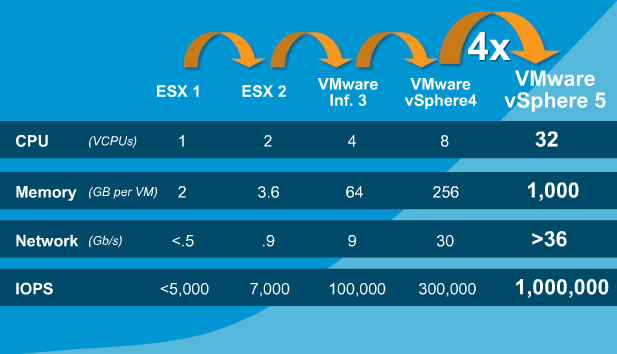
Let’s shift focus for a moment and talk about the performance capabilities of the ESX/ESXi hypervisor as this seems to be argued as an significant overhead which prevents a VSA from being high performance. In my experience , ESXi has never been a significant I/O bottleneck, even for large customers with business critical applications as the focus on Biz Critical Apps really took off around the VI3 days or later where the hypervisor could deliver ~100K IOPS per host.

The below is a chart showing VMware’s tested capabilities from ESX 1, through to vSphere 5 which was released in July 2011.
IOPSvmware

What we can clearly see is vSphere 5.0 can achieve 1 Million IOPS (per host), and even back in the VI3 days, 100,000 IOPS.

In 2011, VMware wrote a great article “Achieving a Million I/O Operations per Second from a Single VMware vSphere® 5.0 Host” which shows how the 1 million IOPS claim has been validated.

In 2012 VMware published “1 million IOPS On 1VM” which showed not only could vSphere achieve a million IOPS, but it could do it from 1 VM.

I don’t know about you, but it’s pretty impressive VMware has optimized the hypervisor to the point where a single VM can get 1 million IOPS, and that was back in 2012!

Now in both the articles, the 1 million IOPS was achieved using a traditional centralised SAN, the first article was with an EMC VMAX with 8 engines and I have summarized the setup below.

  • 4 quad-core processors and 128GB of memory per engine
  • 64 front-end 8Gbps Fibre Channel (FC) ports
  • 64 back-end 4Gbps FC ports
  • 960 * 15K RPM, 450GB FC drives

The IO profile for this test was 8K , 100% read, 100% random.

For the second 1 million IOPS per VM test, the setup used 2 x Violin Memory 6616 Flash Memory Arrays with the below setup.

  • Hypervisor: vSphere 5.1
  • Server: HP DL380 Gen8
    CPU: 2 x Intel Xeon E5-2690, HyperThreading disabled
    Memory: 256GB
  • HBAs: 5 x QLE2562
  • Storage: 2 x Violin Memory 6616 Flash Memory Arrays
  • VM: Windows Server 2008 R2, 8 vCPUs and 48GB.
    Iometer Config: 4K IO size w/ 16 workers

For both configurations, all I/O needs to traverse from the VM, through the hypervisor, out HBAs/NICs, across a storage area network, through central controllers and then make the return journey back to the VM.

There is so many places where additional latency or contention can be introduced in the storage stack it’s amazing VMs can produce the level of storage performance they do, especially back 3 years ago.

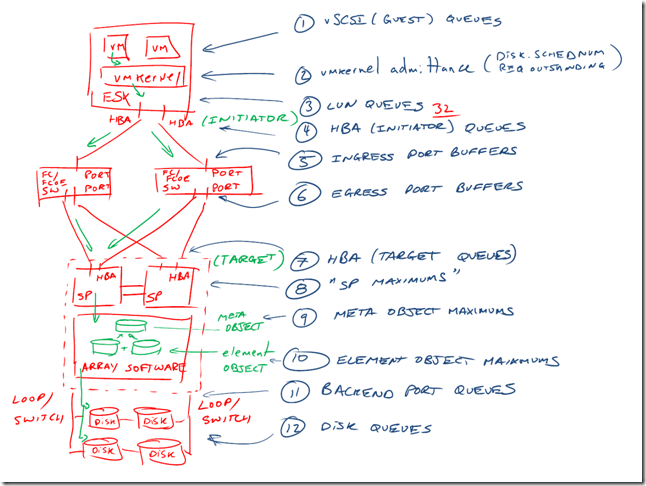
Chad Sakac wrote a great article back in 2009 called “VMware I/O Queues, Microbursting and Multipathing“, which has the below representation of the path I/O takes between a VM and a centralized SAN.
6a00e552e53bd28833011570408872970c

As we can see, Chad shows 12 steps for I/O to get to the disk queues, and once the I/O is completed, the I/O needs to traverse all the way back to the VM, so all in all you could argue it’s a 24 step round trip for EVERY I/O!

The reason I am pointing this out is because the argument around “In-kernel” verses “Virtual Storage Appliance” is only about 1 step in the I/O path, when Hyper-Converged solutions like Nutanix (which uses a VSA) eliminate 3/4’s of the steps in an overcomplicated I/O path which has been proven to achieve 1 million IOPS per VM.

Andre Leibovici recently wrote the article “Nutanix Traffic Routing: Setting the story straight” where he shows the I/O path for VMs using Nutanix.

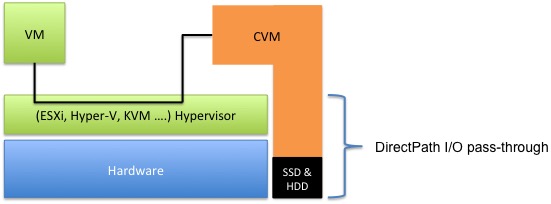
The below diagram which Andre created shows the I/O path (for Read I/O) goes from the VM, across the ESXi hypervisor to the Controller VM (CVM) which then using DirectPath I/O to directly access the locally attached SSD and SATA drives.
nutanix_datapath3

Consider if the VM in the above diagram was a Web Server and the CVM was a database server and they were running in an environment with a SAN/NAS. The Web Server would be communicating to the DB server over the network (via the hypervisor) but the DB Server would have to access it’s data (that the Web Server requested) from the centralized SAN, so in the vast majority of environments today (which are using SAN/NAS) the data is travelling a much longer path than it would compared to a VSA solution and in many cases traversing from one VM to another across the hypervisor before going to the SAN/NAS and back through a VM to be served to the VM requesting the data.

Now back to the diagram, For Nutanix the Read I/O under normal circumstances will be served locally around 95% of the time, this is thanks to data locality and how Write I/O happens.

For Write I/Os, one copy of each piece of data is written locally where the VM is running which means all subsequent Read I/O can be served locally (and freshly written data is also typically “Active data”), and the 2nd copy is replicated throughout the Nutanix cluster. This means even though half the Write I/O (of the two copies) needs to traverse the LAN, it doesn’t hit a choke point like a traditional SAN, because Nutanix scales out controllers on a 1:1 ratio with ESXi hosts and writes are distributed throughout the cluster in 1MB extents.

So if we look back to Chad’s (awesome!) diagram, Hyper-converged solutions like Nutanix and VSAN are only concerned with Steps 1,2,3,12 (4 total) for Read I/O and 1,2,3,12 as well as 1 step for the NIC at the source & 1 step for the NIC at the destination host.

So overall it’s 4 steps for Read, 6 steps for Write, compared to 12 for Read and 12 for Write for a traditional SAN.

So Hyper-converged solutions regardless of In-Kernel or VSA based remove many of the potential points of failure and contention compare to a traditional SANNAS and as a result, have MUCH more efficient data paths.

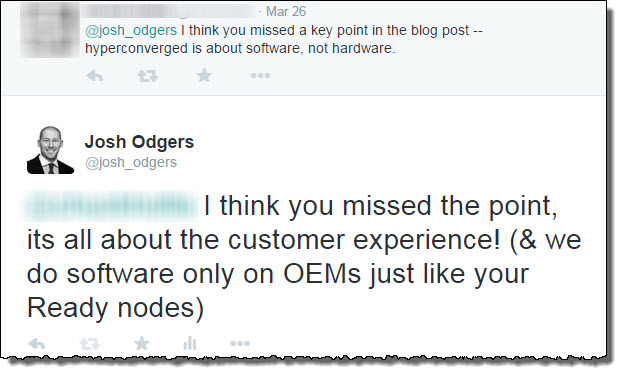
On twitter recently, I responded to a tweet where the person claims “Hyperconverged is about software, not hardware”.

I disagree, Hyper-converged to me (and the folk at Nutanix) is all about the customer experience. It should be simple to deploy, manage, scale etc, all of which constitute the customers experience. Everything in the datacenter runs on HW, so I don’t get the fuss on the Software only vs Appliance / OEM software only solution debate either, but this is a topic for another post.
TweetAboutCustomerExperience

I agree doing things in software is a great idea, and that is what Nutanix and VSAN do, provide a solution in software which combines with commodity hardware to create a Hyper-converged solution.

Summary:

A great customer experience (which is what I believe matters) along with high performance (1M+ IOPS) solution can be delivered both In-Kernel or via a VSA, it’s simple as that. We are long past the days where a VM was a significant bottleneck (circa 2004 w/ ESX 2.x).

I’m glad VMware has led the market in pushing customers to virtualize Business Critical Apps, because it works really really well and delivers lots of value to customers.

As a result of countless best practice guides, white papers, case studies from VMware and VMware Storage Partners such as Nutanix, we know highly compute / network & storage intensive applications can easily be virtualized, so anyone saying a Virtual Storage Appliance can’t (or shouldn’t) be, simply doesn’t understand how efficient the ESXi hypervisor is and/or he/she hasn’t had the industry experience deploying storage intensive Business Critical Applications.

To all Hyper-converged vendors: Can we stop this ridiculous debate and get on with the business of delivering a great customer experience and focus on the business at hand of taking down traditional SAN/NAS? I don’t know about you, but that’s what I’ll be doing.

The new standard in Enterprise Architecture certifications

I am very proud to have been selected to be part of a team of absolute superstars who in the last few months have developed what I believe will be the new standard in Enterprise Architecture certifications, the Nutanix Platform Expert (NPX).

The NPX was developed under the guidance of Lisa O’Leary, a PhD psychometrician and recognized authority in the development of expert-level panel-based assessments for the IT industry. This was a real eye opener for me into how to create a scoring rubric and how to ensure different examiners score as evenly as possible to ensure consistent results.

The NPX certification (along with Nutanix nu.School Education) is designed to produce and certify the best of the best enterprise architects with the main goal of ensuring customers get the best architects to design and deliver solutions which solve real world business problems while maximizing value and reducing ongoing costs.

During the development of NPX, myself and other members of the group basically decided that none of us should be able achieve NPX without each of us putting in significant time and effort to improve our skills, especially as it is required to demonstrate expertise both architecturally and hands on in multiple hypervisors and vendor software stacks. Considering the talent in the group, this was a big call!

I personally am enjoying the challenge of preparing my submission for the NPX based on a large scale project I am working on at the moment, and look forward to submitting my application and hopefully being invited to the Nutanix Design Review (NDR) to defend. I can already tell you this is more comprehensive than any single design I have done to date, and it will be a blast to defend.

So what will being an NPX mean?

Certified graduates of the NPX Program will have a very unique set of skills, including the demonstrated ability to deliver enterprise-class Web-scale solutions using multiple hypervisors and vendor software stacks on the Nutanix platform (VMware® vSphere®, Microsoft® Hyper-V®, and KVM).

This hypervisor agnostic certification for Enterprise Architects is a first in the industry; our groundbreaking approach allows an NPX the freedom to design cutting-edge Web-scale solutions for customers based solely on their business needs.

The depth and breadth of the solution design and delivery skills validated through our peer-vetted program make NPX the new standard for excellence. In accordance with program goals every NPX will be a superb technologist, a visionary evangelist for Web-scale, and a true Enterprise Architect – capable of designing and delivering a wide range of cutting-edge solutions; custom built to support the business goals of the Global 2000 and government agencies in every region of the world.

So what’s required to achieve NPX?

The first prerequisite is the Nutanix Platform Professional (NPP) certification. The NPP is really the entry level certification showing core Nutanix knowledge.

As per the NPX Application, the NPX certification is a two-stage process;

Stage 1 being a review of a candidate’s NPX Program Application.

If a candidate’s application is accepted they will be invited to participate in the NPX Design Review (NDR).

Now at this stage you’re probably saying, this doesn’t seem that hard, right?

Well, here is an idea of the required documentation:

  • A current state and operational readiness assessment
  • A Web-scale migration and transition plan
  • Documentation of specific business requirements driving the solution design
  • Documentation of assumptions that impacted the solution design
  • Documentation of design constraints that impacted the design and delivery of the solution
  • Documentation describing risks identified in the design and delivery of the solution and how those risks
  • A solution architecture including a conceptual/logical and physical design with appropriate diagrams and descriptions all functional components of the solution
  • Documentation of operational procedures and verification

The documentation set goes well beyond any certification I am aware of, but more importantly demonstrates a candidates ability to produce documentation which ensures the solution can be implemented , validated and operated in the event the lead architect is unavailable. This is a very high standard of documentation which I’ve rarely seen in my career.

In addition, 3 Professional references will also be required to validate the candidates experience.

Stage 2 being the NDR is modeled after an academic viva voce defense (live, oral exam) and requires candidates to present their solution to, and answer questions posed to them by NPX-Certified Examiners (NCE). The NDR also includes a series of hands-on exercises, which must be completed by the candidate. Successful completion of both stages is required to earn the NPX credential.

The NPX has a strict policy regarding fictitious solution designs.

NPX candidates may not submit wholly fictitious designs.

I pushed for this during the development of the certification as in my opinion, an enterprise architect should have a portfolio of work to choose from which negates the requirements to create a fictitious design.

In saying that, Partially fictitious designs are permitted when an existing design requires additions or enhancements in order to demonstrate competence in required knowledge areas (e.g., a backup or DR solution may be added if this component was outside the scope of the original design).

Adapting an existing 3-tier solution design to the Nutanix platform is also permitted. In either case the submitted design should contain a majority of solution components architected to support applications with service level agreements specified by actual business stakeholders.

The NDR itself requires the completion of an exercise involving a live Nutanix environment and completion of a design scenario. Both exercises will require demonstration of NPX-level solution design and delivery skills with a second solution stack/hypervisor.

An NPX candidate is permitted to choose the hypervisor you will be tested on during your NDR (it must be different from the hypervisor utilized in the submitted solution design). The hypervisor selected will be used for the Hands-on and Design scenarios during the NDR.

The Hypervisor choices are:

  • VMware® vSphere®
  • Microsoft® Hyper-V®
  • KVM

What next?

I would encourage all enterprise architects to stay tuned for the release of more NPX details via the Nutanix nu.School website and take on the challenge of NPX and become a better architect in the process.

The Nutanix Platform Expert Official Certification Guide is currently being written and should be released at Nutanix .NEXT this coming June.

Summary:

I really enjoyed working with such a talented group of people in developing NPX, and I look forward to being a part of the program firstly as a candidate and as a certified examiner in the future to ensure the quality of Enterprise Architects in the industry only gets better!

Here is a group shot of on the final day of NPX development in San Jose.

Names (Left to right): Derek Seaman , Steven Poitras, Jon Kohler, Ray Hassan, Bas Raayman, Raymon Epping, Josh Odgers, Michael Webster, Artur Krzywdzinski, Samir Roshan, Lane Laverett, Mark Brunstad and Richard Arsenian.

Absent for Photo: Magnus Andersson , Lisa O’Leary, PhD Psychometrician.

NPXDevTeam